
RESTNOVA · Simplify
Occam’s Razor: Why Smart People Stay Stuck
Why smart people stay stuck, and the old blade that cuts the way free.
Open this episode on YouTube →
The One Idea
Smart people stay stuck not for lack of ability but because of it. Intelligence is a magnifier: it sees every risk, every flaw, every better path still to be found, and a mind that sees all of this can argue itself out of any beginning while calling the argument wisdom. The map is not the mountain, and the brightest minds are the ones most able to confuse them.
- A thousand answers can be heavier to carry than none at all. Most stuck lives are not confused; they are merely overloaded.
- Knowledge can become so convincing a substitute for movement that we call ourselves travelers while sitting perfectly still.
- Occam’s blade, turned toward a life: when many roads will serve, do not gather them all. Cut away until one remains.
- Clarity is not certainty. Clarity is the willingness to choose without it, because the case is never truly closed.
- A whole heart on an imperfect path will always outclimb a divided heart on the perfect one.
Principle: Simplify (REST) · The trap: the cold lantern of overthinking · The anchor: William of Occam, Occam’s Razor
The Parable, Block by Block
Below is the video’s full narration, exactly as spoken, with a short teaching under each passage: what the image means, where the trap is hiding, and what the moment asks of you.
Block 1 · Slide: The Capable One Who Never Moves
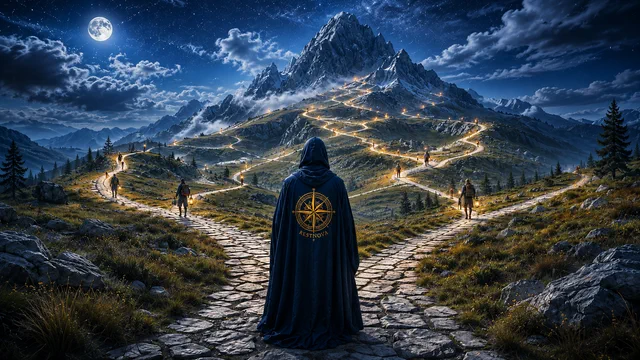
The opening frame stages the paradox before the narration finishes stating it: one figure stands motionless at the foot of the mountain while fainter travelers are already climbing its slopes. Everyone is in motion but him, and he is the gifted one. Hold on the last sentence, because it carries the episode’s whole architecture: the cage is not cruder for a sharp mind, it is finer. Better built. Harder to see. The most capable prisoners construct the most invisible walls.
Block 2 · Slide: The Mind as Lantern
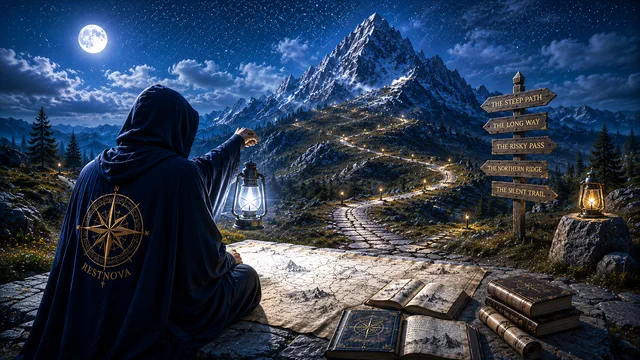
Here the episode states its color law. The lantern over the maps is bright, brilliant even, and cold: In this parable, intellect is rendered as cold light, and warmth is reserved for something else entirely, which the story will reveal in time. The narration’s inversion deserves a pause too. We treat answers as weightless, as pure gain. The parable weighs them. A thousand of them make a load no traveler can carry uphill.
Block 3 · Slide: Not What’s Missing
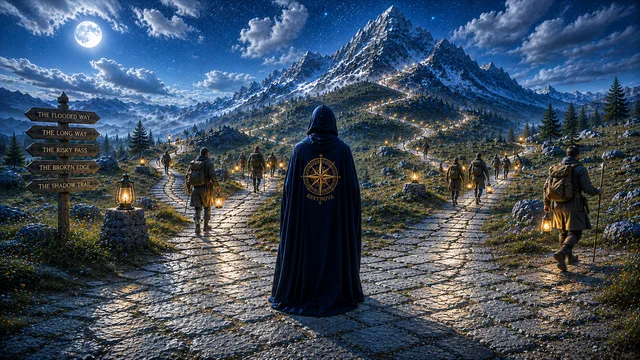
The diagnosis inverts. Every common explanation for stuckness is a deficiency story, something absent that must be supplied, and the entire self-improvement industry is built on selling the missing part. This block closes that door. Nothing is missing. Something is present, in abundance, and misdirected. That changes the cure completely: you cannot fix an excess by adding more.
Block 4 · Slide: The Magnifier
The trap is named, and the image shows its mechanism: through the lens, every path on the map branches into countless fainter lines, a cold web of possibility that grows denser the harder you look. That is what a magnifier does. It does not create the risks; it makes all of them visible at once, at equal size, until the view itself is the obstacle. And note the trap’s finishing move, the one that seals the cage: it makes stillness sound like wisdom. A promise is planted here as well. An old friar forged a blade for exactly this tangle, and the tangle the blade will cut is already on the screen. The story must come first; the blade will be taken up when the story has earned it.
Block 5 · Slide: Many Roads
The parable opens on the mountain laced with pale switchback roads climbing into mist, and on a traveler whose assumption is entirely reasonable: the best eyes should make the best climber. Every gifted person has made this bet. The story exists to examine why it fails, and the failure begins in the very next block, in the most innocent verb imaginable.
Block 6 · Slide: Mapping Every Road
Watch the composition, because it tells the truth before the narration does: the traveler crouches in his pool of lantern-light, absorbed in the charts, while the real mountain stands behind him as a dark shape, barely glanced at. Knowledge of the mountain is quietly replacing sight of it. And nothing in his study is false. Every observation is accurate. The parable’s honesty is that the trap is built entirely out of true things.
Block 7 · Slide: Waiting for the Perfect Path
Here is this episode’s version of the trap’s sentence, and like all of them, it will be spoken in your own voice: when I know the best path, I will take it. The narration grants what makes it so durable: it is a reasonable thing to say. But look at what the sentence quietly demands as its price of departure: a road with no flaw, a choice beyond all future regret. Neither exists. The condition can never be met, which means the promise can be kept forever without ever being fulfilled. Behind the seated figure, a faint moon marks patience curdling into delay.
Block 8 · Slide: The Wall of Objections
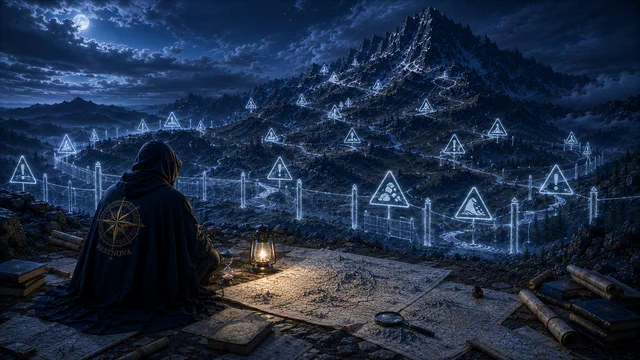
The slide builds the wall so you can see what it is made of: every road on the slope marked with a cold, accurate warning, a flooded line, a broken bridge, a fall of stone, until the mountain looks fenced behind hazards. The fence is luminous. It is made of light, of knowledge, of things correctly seen. That is what makes this prison different from the last episode’s warm one: no comfort holds him here. He is held by facts, each one true, arranged into a wall no single truth intended.
Block 9 · Slide: The Simple Climbers
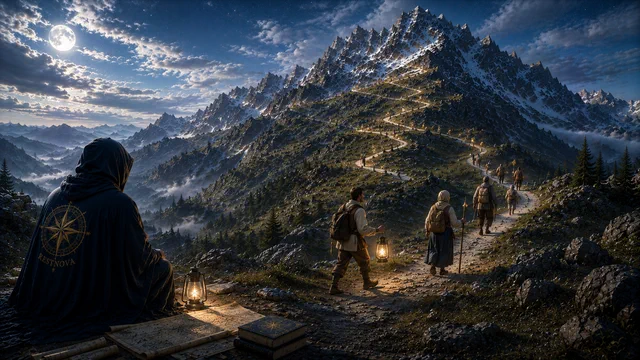
Now the episode reveals where it has been hiding its warmth: the climbers carry small warm lanterns up the cold slope. In this parable, warmth belongs to movement. Be careful with this block, because it is not praising ignorance; the story never claims the simple climbers were wiser, only that they were moving. The point is proportion. Their knowledge was small enough to carry. His had grown too heavy to lift, and the last two sentences state the strange arithmetic plainly: the dangers he alone could see were the only dangers doing any stopping.
Block 10 · Slide: One Road

The sharpest line in the parable belongs to a passing stranger, and the frame sets the two of them side by side as two kinds of light: his cold lantern bent over the maps, her small warm one already turned toward the slope, with ONE ROAD written in her gold. Read her sentence twice, because it is a complete diagnosis in twelve words. She has named his actual burden. Not the mountain, not the dangers: the needing them all. Requiring every road is a way of walking none, and she does not stay to argue the point. She climbs, which is the only rebuttal the parable respects.
Block 11 · Slide: The Wisest Who Never Climbed
Time passes, and the trap pays its terrible consolation: he becomes respected, consulted, the authority at the crossroads. The pull-back in this frame reveals how much he has gathered and how little he has moved; the ground beneath his feet is worn smooth from standing. This is the trap’s deepest cunning: it rewards its prisoner. There is real status in being the one who knows, and that status can substitute for arrival so convincingly that the difference stops being felt. He can describe the summit exquisitely. The parable lets one quiet sentence carry all the grief: he had simply never stood upon it.
Block 12 · Slide: The Map Is Not the Mountain
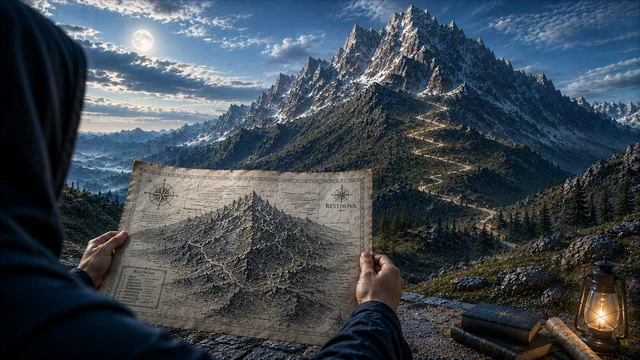
The lesson, stated at last, and the image argues it wordlessly: a gorgeous, intricate map held up against the real peak behind it, the focus sliding from the flat cold paper to the deep dimensional dark of the actual mountain. The two are clearly not the same thing, and yet an entire life was spent inside the confusion. This is the sentence to carry out of the video if you carry nothing else: to know a path is not to walk it. Everything after this block is about how to stop knowing and start walking.
Block 13 · Slide: The Friar’s Blade
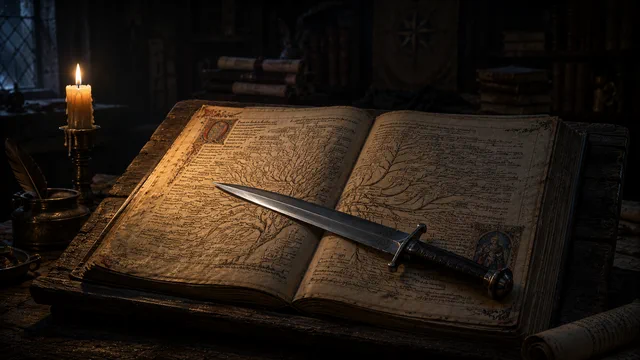
The promised blade is taken up. William of Occam was a fourteenth-century Franciscan friar and one of the sharpest logicians of the medieval world, and the principle that bears his name, Occam’s Razor, is rendered here in close and faithful paraphrase, not invented quotation: prefer the simplest sufficient explanation, and never multiply what need not be multiplied. One honest note on attribution: the famous slogan in that polished form was crystallized by later writers summarizing his method; Occam’s own surviving formulations say the same thing in scholastic dress, that plurality should never be posited without necessity. The razor is genuinely his in spirit and rightly wears his name. The narration is equally honest about its own move: he meant it for ideas, and the extension from explanations to roads is the parable’s teaching, not the friar’s claim. Look at the slide itself: a candle-lit manuscript in deep blue darkness, and lying across a page dense with branching, web-like diagrams, one simple, unadorned blade. The tangle from the magnifier has returned, and now something rests on top of it that was made to cut. The restrained antique warmth of the candle is deliberately neither the episode’s cold mind-light nor the dawn’s true gold. It is the register this series reserves for inherited wisdom, the light of the lineage itself.
Block 14 · Slide: Clarity Without Certainty
A distinction most clever minds have never been offered, because the two words are used as synonyms everywhere else. Certainty is a property of information: complete, verified, closed. Clarity is a property of the chooser: willing, present, resolved. The traveler waited a lifetime for the first while possessing everything required for the second. The image holds the exact threshold: one road faintly clearer than the rest, a hand reaching toward it, not yet stepping. The gap between knowing and choosing is only as wide as that hand’s hesitation, and no amount of further study narrows it. Only the willingness does.
Block 15 · Slide: Servant, Not Master
This block protects the teaching from its cheap imitation, exactly as every RESTNOVA parable pauses to do. The lesson is not anti-intelligence; a story that scolded the gifted for their gift would be both false and useless. Watch what the image does instead of discarding the lantern: it turns it. The same cold light that spent the whole episode pointed down at the page is now held forward, thrown onto the path ahead. Nothing about the mind changes except its position in the procession. Servant, not master. Torch, not residence. The distinction between a place you live and a light you carry is the whole repair.
Block 16 · Slide: Simplify
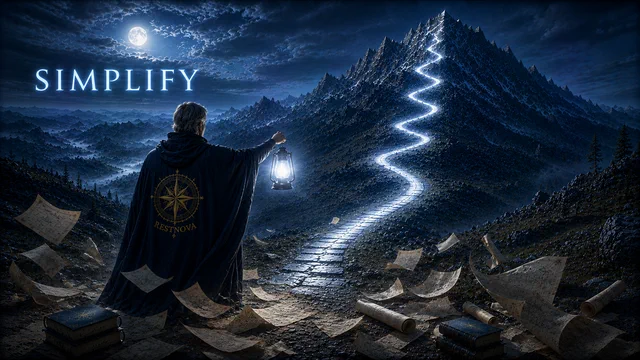
The episode’s work takes its place in the REST sequence: SIMPLIFY, written in blue-white as the hundred faint roads dissolve into one clean luminous line and the clutter of maps falls away at the traveler’s feet. Notice why the clever mind resists this particular work: every other form of self-improvement flatters intelligence by asking it to acquire, and acquisition is what it does best. Simplification asks it to subtract, to release verified, hard-won knowledge on purpose, and that feels like loss. It is not loss. It is the shedding every climb requires. The closing distinction is the most freeing sentence in the video: not confused, merely overloaded. Confusion needs more answers. Overload needs fewer.
Block 17 · Slide: A Whole Heart on One Path
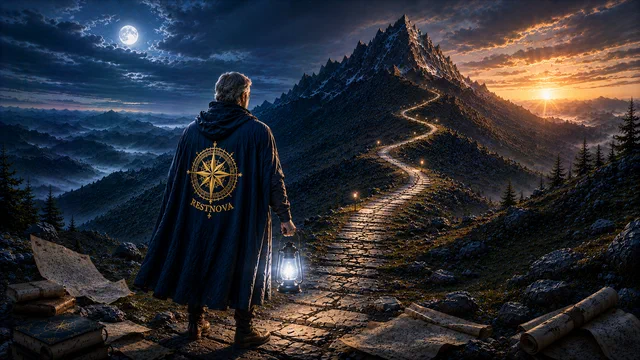
The traveler stands in this frame for the first time in the story, maps set down, shoulders squared to a single road: decisive rather than learned. The final sentence is the parable’s arithmetic and deserves to be tested against your own history, because everyone has watched it prove true. The advantage was never in the quality of the road. It was in the wholeness of the heart walking it. A divided heart re-litigates the choice at every hard step, and the perfect path cannot survive a walker who is still comparing it to the others.
Block 18 · Slide: Your Own Crossroads
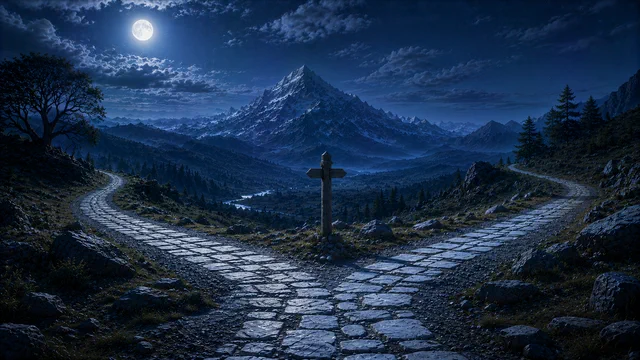
The frame empties. An unoccupied crossroads under cool, still light: a place left open for you to stand. The search instruction is precise, so use its precision. You are not looking for laziness; the overthinker is usually working very hard. You are looking for the place where the studying is the working, where research has quietly become the deliverable, where the examining itself became the journey. Everyone gifted with a good mind has at least one of these. Name yours before the next block asks you to shrink it.
Block 19 · Slide: Choose
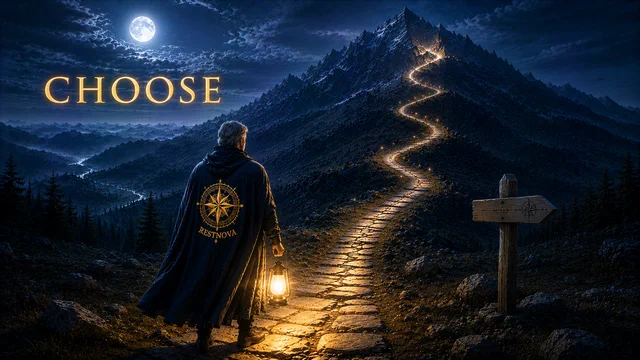
The first true gold of the episode touches the foot of one road: CHOOSE, written in it, while the rest of the slope softens into shadow. The practice is a demotion of the question itself, from which road is perfect, a question that can be studied forever, to which road could I begin today, a question that answers itself by tonight. And the closing image earns its place among the finest in the series: a climber lets go of the ground without grief because holding it and ascending are physically incompatible. The other roads are your ground. Releasing them is not a loss you suffer on the way up. It is the way up.
Block 20 · Slide: Setting Down the Maps
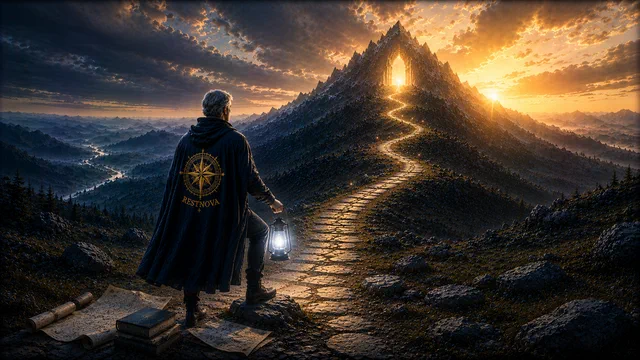
Mark what the parable calls brave. Not the climb, with all its catalogued dangers; the setting down of the maps. For this traveler, that was the summit before the summit, the surrender of a lifetime’s identity as the one who knows. The frame gives the moment the series’ signature threshold: maps laid on the ground, eyes lifted from page to peak, one foot on the road, and behind the summit the first true gold breaking, the way ahead opening like an arch of light. The narration is honest to the end: the foot is uncertain, the road is not the best one. It is merely real, and real is the only kind that climbs.
Block 21 · Slide: Climb
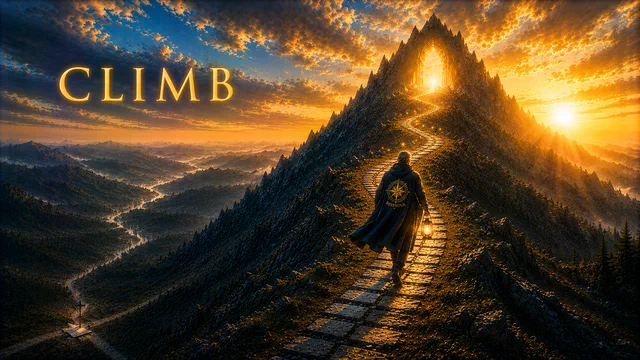
The final frame opens wide: the traveler small on the mountain road at last, the crossroads and its maps a fading speck below, the sky balancing cold blue and earned, expansive gold, with CLIMB written over the ascent. The closing address honors the gift one last time before naming its danger in six words: the room you never leave. A remarkable mind should be a vehicle, and the moment it becomes a residence, all its horsepower turns inward. The two closing questions are the video’s assignment, restated as prompts below. Answer the second one especially, in writing, before the day hands you another reason to keep deciding.
About William of Occam and the Razor
William of Occam (c. 1287–1347) was an English Franciscan friar, philosopher, and theologian, and one of the great logicians of the medieval world. Born in the village of Ockham in Surrey, he studied and taught at Oxford, quarreled famously with a pope over the poverty of the church, spent his later years in exile writing under imperial protection, and left behind a body of rigorous scholastic work on logic, language, and knowledge that still shapes philosophy seven centuries on.
The principle that carries his name, Occam’s Razor, is a rule of economy in explanation: when several explanations account for the same thing, prefer the one that assumes the least, and never multiply entities beyond necessity. One honest note the video’s anchor commentary also carries: the polished slogan in that form was distilled by later writers summarizing his method. Occam’s own surviving formulations make the same demand in scholastic language, that plurality should never be posited without necessity, and he wielded the principle relentlessly. The razor is his in spirit and practice, and it wears his name honestly.
The video paraphrases the razor faithfully rather than quoting it, and it is candid about its own extension: Occam sharpened the blade for ideas, for trimming bloated explanations, and the parable turns the same edge toward a life, cutting a hundred studied roads down to one walked one. The friar might have appreciated the economy of that. He spent his career insisting that what need not be multiplied should not be, and few things multiply more freely than a clever mind’s reasons to wait.
Questions to Sit With
The traveler lost a lifetime to questions that could be studied forever. The video leaves you with the kind that can only be answered by a step. Taken together, they make a short evening’s journaling, best finished before the research reopens.
- What have you been studying so long that you have forgotten to begin?
- Where has the examining itself become the journey: the work researched but never begun, the decision turned over from every angle and never made?
- Which road could you begin today? Not the perfect one, a real one. What is the first small step it asks of you?
- What would you have to let go of, the way a climber lets go of the ground, to give one path your whole heart?
Frequently Asked Questions
What is Occam’s Razor?
Occam’s Razor is the principle that when many explanations will serve, the simplest should be chosen: never multiply what need not be multiplied. Named for William of Occam, a fourteenth-century Franciscan friar and logician, it began as a rule for thinking clearly about ideas. This video turns the same blade toward life: when many roads will serve, cut away until one remains.
Why do smart people stay stuck?
Smart people stay stuck because intelligence is a magnifier. A sharp mind sees every risk, every flaw in every plan, every better option not yet found, and it can argue itself out of any beginning while calling that argument wisdom. The problem is rarely too few answers. A thousand answers can be heavier to carry than none at all.
Did William of Occam really say “entities must not be multiplied beyond necessity”?
Not in those exact words, as far as his surviving writings show. The famous Latin slogan was crystallized by later writers summarizing his method. Occam did argue repeatedly for economy in explanation, in formulations such as that plurality should never be posited without necessity, so the razor genuinely reflects his thinking. The slogan is a distillation, and it carries his name honestly.
How do I stop overthinking and finally decide?
Make the choice smaller. You do not need the best path; you need a path, and the will to walk it. Ask not which road is perfect but which road you could begin today, choose it, and let the others go. Clarity is not having all the information; it is the willingness to act before the case is closed, because the case never truly closes.
What does “the map is not the mountain” mean?
It means that knowing a path is not the same as walking it. Knowledge can become so convincing a substitute for movement that we mistake the one for the other and call ourselves travelers while sitting perfectly still. The map is flat, detailed, and safe; the mountain is real. Study serves the climb only when it ends in a step.
What is the RESTNOVA framework?
RESTNOVA is an eight-part framework for transformation in two halves. REST (Reflect, Evaluate, Simplify, Transform) is the inner work: who you become. NOVA (Navigate, Optimize, Visualize, Achieve) is the outer work: what you create. The order matters: personal transformation comes first, and meaningful achievement grows out of it.
Every RESTNOVA video stands alone, and together they follow one traveler through the eight works of REST and NOVA.
Simplify is the third work of REST. The full framework is here.
RestReflect · Evaluate · Simplify · Transform
NovaNavigate · Optimize · Visualize · Achieve