
RESTNOVA · Evaluate
What Seneca Knew About Comfort (That We Forgot)
The hidden cost of comfort, and the fire we keep calling rest.
Open this episode on YouTube →
The One Idea
Seneca saw that we guard our money jealously and spend our time freely, protecting the one thing that can be replaced while squandering the only thing that cannot. What we forgot is comfort’s part in the squandering. The hidden cost of comfort is a cost of omission: it never takes what you already have. It takes what you would have become.
- The most dangerous prison has no walls. It doesn’t feel like a prison because its walls are made of everything you love.
- Comfort sends no bill. The price is paid in a currency you never notice leaving, and by the time the cost is clear, years have been spent.
- The error is never in stopping; it is in staying. Rest is meant to restore the journey, never to replace it.
- False warmth is small and enclosing; true gold is wide and earned. The fire’s amber is not the dawn’s.
- One question separates the traveler from the one who stays: is this rest, or is this hiding?
Principle: Evaluate (REST) · The trap: the enclosing firelight · The anchor: Seneca, On the Shortness of Life
The Parable, Block by Block
Below is the video’s full narration, exactly as spoken, with a short teaching under each passage: what the image means, where the trap is hiding, and what the moment asks of you.
Block 1 · Slide: The Valley at Night

The paradox that opens this video is the whole teaching in miniature: an open door imprisons better than a locked one. A locked door produces prisoners who fight to get out; an open one produces prisoners who explain why they stay. Look at how the first frame introduces the prison. It is a single point of warm light in an immense dark valley, so small it could be mistaken for one more star. From this distance, the trap is indistinguishable from salvation. That is not an accident of composition. It is the trap’s whole method.
Block 2 · Slide: The Traveler at the Fire
Every trap in this series has a disguise, and comfort’s is the kindest of them all: it arrives as something you have earned. Enemies can be fought and hardships endured, but a reward asks nothing of you except that you accept it.
Block 3 · Slide: The Expected Threat vs. the Real One

We are well defended on the wrong side. A lifetime of bracing for storms leaves the gentle approach unwatched, and the gentle approach is where the theft happens; the camera itself makes the argument, panning away from the bruised storm-horizon toward the calm firelit hollow, moving your eye from the threat you fear to the one that costs you. Note the precise verb: comfort does not break a life, it keeps one. And a promise is planted here. The Stoics diagnosed this enemy two thousand years ago, and one of them will step into the story once the parable has done its work.
Block 4 · Slide: No Bill Arrives
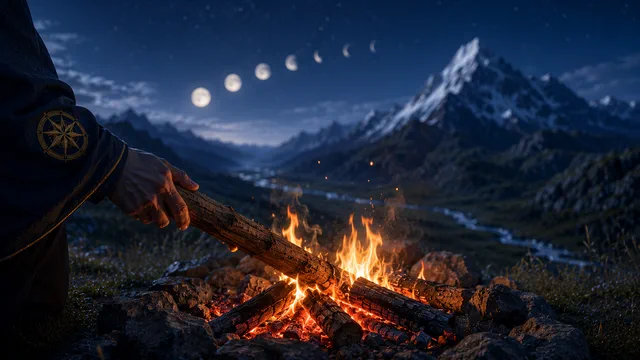
This is the block that gives the teaching its economics, and they deserve slow reading. Everything else in life invoices you promptly. Effort costs sweat, risk costs fear, failure costs pride, so we learn to trust that costly things announce themselves. Comfort is the exception: it bills in arrears, in a currency of unlived days. The frame holds this in one image, a hand feeding a branch to the flames in sharp focus while behind it, blurred almost past noticing, a row of moons fades across the sky. The payment is leaving in the background of the very act that feels like nothing.
Block 5 · Slide: The Story Begins

Mark how the story begins, because everything depends on it: the fire is built for a good reason. The cold is real; the wind is real; the fire is not a mistake but a necessity, and the narration is careful to record its original charter: meaning only to survive until morning. The parable plants its trap in soil of genuine need, and so does life. Almost no one is trapped by pure indulgence. We are trapped by legitimate rest that quietly outlives its charter.
Block 6 · Slide: The Fire That Saves
The fire saved him. The narration grants this without reservation, and the whole episode’s honesty rests on granting it. This is the first warm light in the story, blooming onto the traveler’s hands, and the frame lets it be purely good: relief, survival, no irony. The vow made beside the flames is sincere, just as the traveler’s vows in every RESTNOVA parable are sincere. Sincerity is never the missing ingredient. Watch instead what the warmth does to the vow overnight.
Block 7 · Slide: One More Day
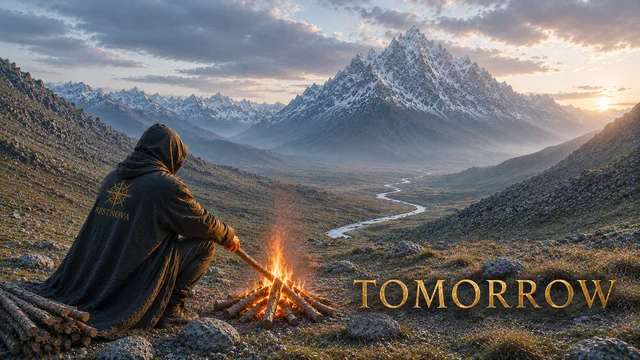
Here is the trap’s exact sentence, and it is worth learning by heart because it will be spoken in your own voice: one more day. Not never. The trap never says never. Watch the traveler’s hand in this frame: it reaches to feed the fire rather than to push himself up, and that small motion is the whole decision. Every postponement is also an investment in the thing that makes postponing easier. The word TOMORROW hangs over the scene in gold, the counterfeit currency in which all of comfort’s debts are denominated.
Block 8 · Slide: The World Shrinks
This slide is the episode’s trap signature at full strength: the enclosing firelight, an amber circle that grows brighter and smaller at once, until it has swallowed the frame and dissolved the mountain into the shadows at its edge. Even the camera participates. It zooms inward, the world contracting to the fire, while the seasons register only as a fallen leaf and a trace of frost at the rim. And the most chilling sentence is the quietest one: he was not unhappy. Misery would have saved him; misery makes people move. Comfort’s deepest power is that it removes the pain that would otherwise force the question.
Block 9 · Slide: “I Am Only Resting”
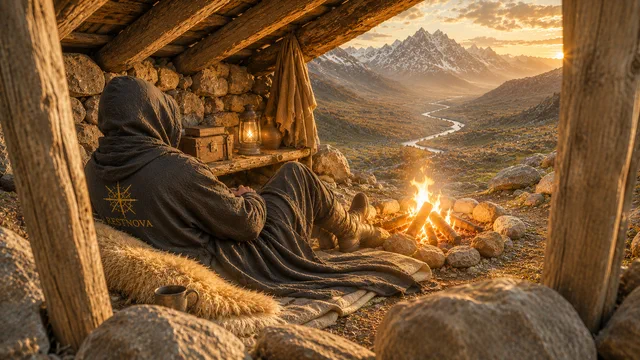
The trap completes itself with language. A man who admitted I have stopped would have to face the stopping; a man who says I am resting has nothing to face at all, because rest implies a climb still coming. The word does the staying for him. The image quietly disagrees with the word: the traveler reclines peaceful, almost noble, and the rocks and shelter beams frame him like soft bars. He has built his cage out of shelter, and the composition can see it even though he cannot. This is why the Evaluate work later begins with naming things plainly. The honest word is the first crack in a wall built of comfortable ones.
Block 10 · Slide: The Turn
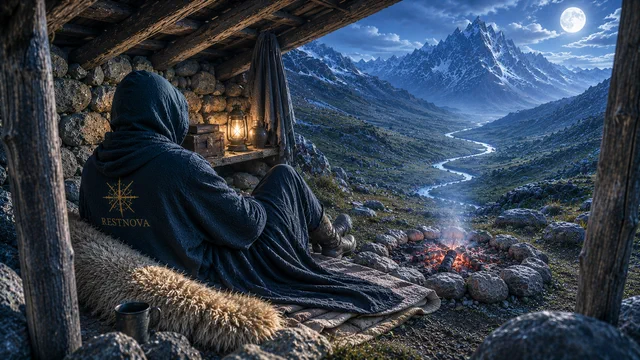
Clarity arrives only when the fire burns low. The parable’s machinery is precise here: the very light he tended is what hid the mountain, and only its failing lets him see. The palette turns with him. Cold moon-silver reclaims the frame from the amber, and in this episode’s color grammar that cold blue is not despair; it is recognition, the honest light of the unchanged self finally looking at itself. What he sees is the anatomy of every long postponement: the reasons for stopping were real once, and they expired; the staying continued on its own. When a habit outlives every reason it was built on, it has stopped being a decision and become a residence.
Block 11 · Slide: The Cost
The accounting, finally rendered. The image renders it as a path of ghostly footprints climbing the mountainside, a thread of pale gold marking the climb never walked, with the camera tilting slowly up its whole length while the seated figure stays small at its base. The last line is the invoice’s true total. The mountain is still there; mountains wait indefinitely. What cannot wait is the self. Every unwalked dawn quietly retired a version of him that the next dawn could not fully recall.
Block 12 · Slide: The Man He Never Became
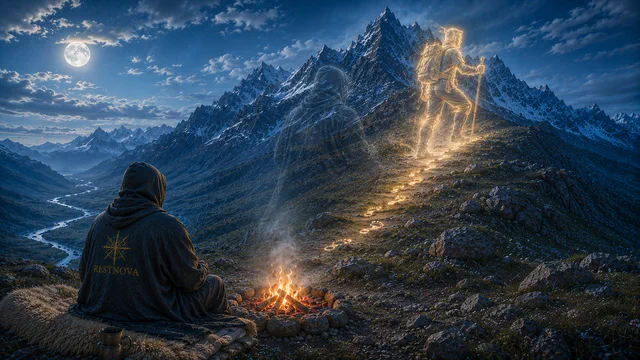
The principle, stated plainly, and the slide gives the invisible loss a body for one frame so it can be seen at all: two translucent figures overlaid, the seated traveler in blue and a stronger, upright self climbing the slope in faint gold, already dissolving as the frame drifts. Losses of possession are visible; we grieve them, and grief forces reckoning. Losses of omission generate no grief because the lost thing never existed to be missed. The final sentence explains why so many comfortable lives end in a sorrow they cannot name: the mourning has nowhere to attach.
Block 13 · Slide: The Voice from Antiquity
The parable pauses for one breath, and its lineage steps forward. This is the promise of Block 3 kept. These lines are close and faithful paraphrase of Seneca’s essay On the Shortness of Life, not invented quotation: the contrast of guarded money and squandered time is his own famous observation, and the closing lines track his best-known warning, that life is not given to us short but made short by waste, and that everything can be replenished except time. Look at what the image does with the fire. The traveler’s blaze reappears shrunk to a scholar’s oil lamp, its small flame lighting only a marble profile and an unrolled scroll in the deep blue dark. Same fire, opposite service; here the flame serves seeing rather than staying. And the lamplight’s restrained antique warmth is deliberately neither the trap’s enclosing amber nor the dawn’s true gold. It is the register of inherited wisdom, the same candle-lit light that fell on James Allen’s book in this series’ first episode. The disease is not modern. Neither is the cure.
Block 14 · Slide: Stopping vs. Staying
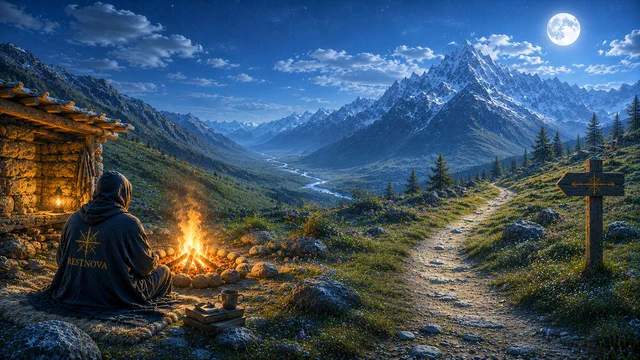
This block protects the teaching from its cheap imitation. A lesser telling would condemn comfort and demand perpetual striving, and would be wrong, and unlivable. The frame makes the fairness visible: fire on one side, open path on the other, given equal weight, the image honoring the fire even as it points past it. The parable’s standard is subtler and harder than condemnation: comfort is judged not by its pleasure but by its service. The same fire, unchanged, crosses from restoration to cage the moment it stops pointing back toward the mountain. Nothing about the fire announces the crossing. Only evaluation can catch it.
Block 15 · Slide: Walls Made of What We Love
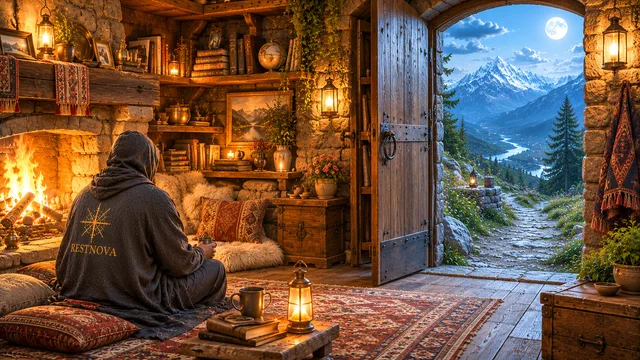
The prison of Block 1 returns, now fully understood, and the image names it: a gilded cage, the shelter rendered genuinely beautiful, warm and treasured, with a single dark open doorway at its edge toward which the frame slowly moves. We are built to flee suffering, so a prison of suffering empties itself; a prison built of loved things has no such flaw. And note what this implies about the exit: it will never happen by drift, accident, or crisis, because nothing inside the cage pushes outward. The leaving must be a deliberate act, made with clear eyes, at full warmth, in daylight, before the fire makes its evening argument again.
Block 16 · Slide: Honest Sight

The episode’s principle takes its place in the REST sequence: EVALUATE, written in blue-white over a dark, still pool where the traveler’s own face looks back. The still water is deliberate inheritance. It is the Reflect imagery of this series, reaching back to the first work of REST, because evaluation is reflection turned assessor: not merely seeing yourself, but judging honestly what you see. Effort is what the culture prescribes first, but effort applied to an unexamined life only decorates the cage. The last sentence is the hard gate: no one escapes a prison they will not name.
Block 17 · Slide: The Question in the Water
The practice, made concrete, and the reflection in the pool sharpens to deliver it: behind the traveler’s reflected face, the mountain now rises in the water, the unspoken question made visible. Honest evaluation always produces this composite image, your face and your unclimbed thing in the same frame, refusing to be viewed separately. The search term is exact: not where am I lazy, which invites shame and produces nothing, but where is the fire I have been calling rest, the good thing that overstayed. Then do what the traveler could not do for years: say its plain name out loud. A named trap loses its favorite word, and with it, most of its hold.
Block 18 · Slide: The True Gold

A crucial correction of method, and the frame states it as color doctrine: for the first time, the summit burns with genuine, expansive gold, wide and earned, visibly nothing like the small enclosing amber of the fire. The episode has been teaching this distinction all along; here it becomes the way out. Self-disgust feels like progress and changes nothing. A man can hate his fire nightly and never leave it, because hatred is still attention paid to the fire. The exit runs through desire, not contempt. The mountain must be remembered, rehearsed, held higher, until wanting outweighs warmth. You do not leave comfort by pushing against it. You leave it by being pulled past it.
Block 19 · Slide: Rest or Hiding
The whole episode compresses into one portable question, sized for daily use, and the frame wears the question on the traveler’s own face, lit half cold from the open dawn air and half warm from the dying fire, with HIDING? hanging in cold white between them. The split lighting is the test made visible: rest and hiding are indistinguishable from the outside, the same stillness, the same warmth, and the distinguishing question is directional. Does this stillness point me back toward the climb, or has it become the destination? No one else can answer it for you. That is not a flaw in the question. It is the question’s point.
Block 20 · Slide: The Threshold
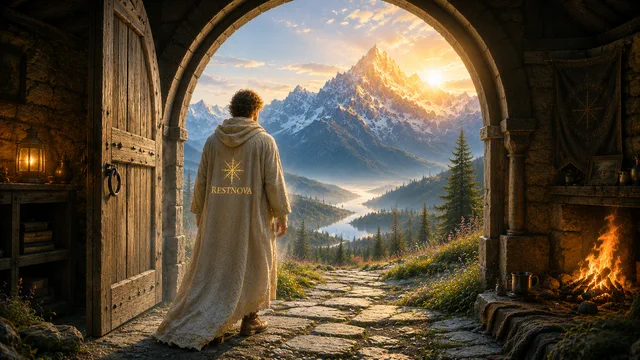
The parable grants its traveler what it hopes for its viewer: a standing-up. The doorway he faces is the series’ signature arch, the RESTNOVA threshold appearing here as the shelter’s own exit, cold blue behind him, widening true gold beyond, the camera pushing slowly through it as if the viewer were the one crossing. Feel the honesty of the details: the cold moves against his face immediately. Leaving comfort costs comfort, at once and every time. And the dawn behind the peak carries the episode’s quiet mercy: almost slept through. Not too late.
Block 21 · Slide: Begin
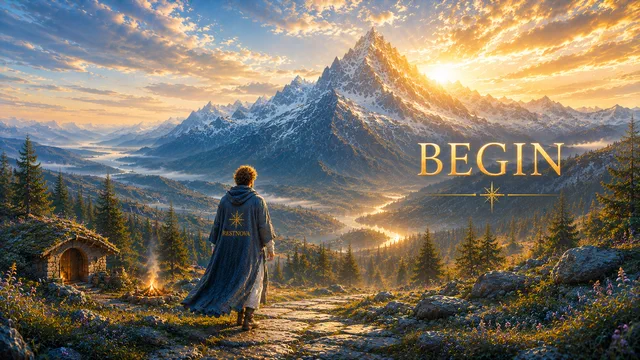
The ending returns to the open door of Block 1, now seen from both sides: the same fact, that you can leave any time, is the mercy that keeps hope alive and the danger that lets leaving be postponed forever. The final frame holds the full arc in one image: the traveler small at the base of the mountain path, the fire a fading speck behind him, the sky opening into cold blue and earned, expansive gold together, the complete movement from who you become toward what you create, with one word over it: BEGIN. The two closing questions are the video’s assignment, restated as prompts below. Answer them today, in daylight. The fire will make its own argument again tonight.
About Seneca and On the Shortness of Life
Lucius Annaeus Seneca (c. 4 BC–AD 65) was a Roman Stoic philosopher, statesman, and playwright: one of the wealthiest and most powerful men of his age, and one of its sharpest observers of how lives are wasted. He served as tutor and adviser to the emperor Nero, survived exile and court intrigue for decades, and wrote the letters and essays that remain, two thousand years on, among the most practical philosophy ever set down.
On the Shortness of Life (De Brevitate Vitae) is his most famous essay, and its argument is a deliberate reversal of the oldest complaint in the world. Life is not short, Seneca insists; it is long enough, and generously given, if all of it were well invested. It only becomes short because so much of it leaks away: into busyness, into postponement, into preparation for a living that never quite begins. His most cutting observation is the one this video’s anchor block carries, that we are misers with our money, which can always be replaced, and spendthrifts with our time, which never can.
The video paraphrases Seneca closely rather than quoting a single translation. The guarded-money observation and the warning about waste and postponement are his, rendered faithfully in the parable’s own cadence, with no invented quotations. The parable of the traveler and the fire is original to RESTNOVA; Seneca supplies its diagnosis. He would have recognized the man beside the fire instantly. He wrote the essay because he had watched a whole city of them.
Questions to Sit With
The traveler needed one honest night to see his fire clearly. The video leaves you its questions in the hope that you will not need years. Taken together, they make a short evening’s journaling, done, ideally, in daylight.
- What fire have you been calling rest? Name the comfort precisely, and name the good reason it was built, because there almost certainly was one.
- Do the original reasons for stopping still exist? Or are the reasons gone, and only the staying remains?
- What have you been postponing until a tomorrow that keeps arriving and keeps finding you exactly where you were?
- Is this rest, or is this hiding? Does your stillness point you back toward the climb, or has it quietly become the destination?
Frequently Asked Questions
What did Seneca say about wasting time?
Seneca observed that we guard our money jealously and spend our time freely, protecting the one thing that can be replaced while squandering the only thing that cannot. In On the Shortness of Life he argued that life is long enough if used well; it only feels short because so much of it is lost to busyness and postponement.
What is the hidden cost of comfort?
The hidden cost of comfort is everything you would have gained but didn’t: a cost of omission. Comfort takes nothing you already have, which is why it feels free. Its price is paid in the days you meant to begin and the person you meant to become, and it comes due in years, not receipts.
What is On the Shortness of Life about?
On the Shortness of Life is Seneca’s essay arguing that life is long enough; it is we who make it short. People complain about time while wasting it on busyness, postponement, and endless preparation for living. The essay urges readers to stop deferring their real life to a tomorrow that is never guaranteed to arrive.
How do I know if I’m resting or hiding?
Ask one honest question each morning: is this rest, or is this hiding? Rest prepares you to rise; hiding only helps you stay. The same comfort can do both. If your stillness keeps pointing you back toward the climb, it is serving the journey; if the reasons for stopping are gone and only the staying remains, it has become hiding.
Is comfort bad for you?
No. In the parable, the fire saves the traveler’s life, and the story insists the fire was good. Comfort becomes costly only when it stops serving the journey and starts replacing it. Rest is meant to restore the climb, never to substitute for it. The error is never in stopping, but in staying.
What is the RESTNOVA framework?
RESTNOVA is an eight-part framework for transformation in two halves. REST (Reflect, Evaluate, Simplify, Transform) is the inner work: who you become. NOVA (Navigate, Optimize, Visualize, Achieve) is the outer work: what you create. The order matters: personal transformation comes first, and meaningful achievement grows out of it.
Every RESTNOVA video stands alone, and together they follow one traveler through the eight works of REST and NOVA.
Evaluate is the second work of REST. The full framework is here.
RestReflect · Evaluate · Simplify · Transform
NovaNavigate · Optimize · Visualize · Achieve